

You’ve been hurt on the job. You’re stressed. You’re panicked. You don’t know what to do. A friend suggests you might qualify for Workers’ Compensation benefits.
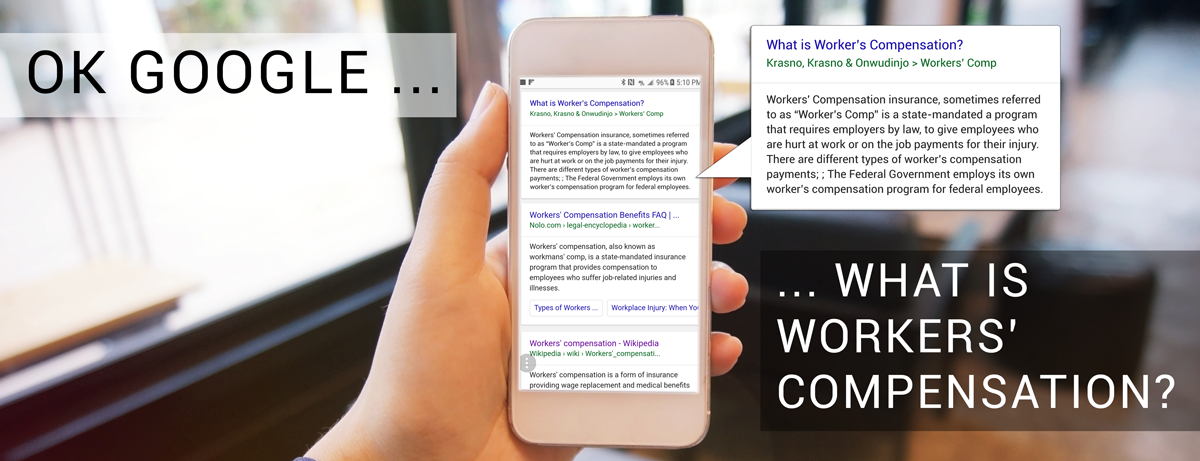
You reach for your phone. And say to it: “Ok Google, what is workers’ compensation?”
That’s where we’re at in this day and age. We’re walking around with the internet in our pockets. Each device houses a massive archive of data that we tap into every day seeking answers. Gone are the times where we reach for a phone book or even dial 411. We go to the internet and investigate. Our search for answers starts with Google, Alexa or Siri.
Well when it comes to your question about what is workers’ compensation, look no further. The expert team of Work Injury Lawyers at Krasno, Krasno & Onwudinjo have assembled the definitive answer to your question.
Definition of Workers’ Compensation
Workers’ Compensation insurance, sometimes referred to as “Worker’s Comp” is a state-mandated a program that requires employers by law, to give employees who are hurt at work or on the job payments for their injury. There are different types of worker’s compensation payments; The Federal Government employs its own worker’s compensation program for federal employees. Every state has its form of worker’s compensation as well. It is essential to check what the employee’s compensation laws are in your state. To find accurate information, check your state department’s website, to learn all you need to know about Workers’ Compensation.
In most situations, worker’s who are hurt on the job or have undergone a work-related illness will receive workers’ compensation benefits regardless of who was at fault. The workers’ compensation benefits act as a buffer; They stop the employee from having the right to sue the employer under for the injury that they have undergone. This is usually known as “The Compensation Bargain.”
One of the problems that come along with this bargain is employers not wanting to pay the amount needed for the high reward. The collective liability system was created to prevent this, and to ensure overall security to workers. Individual immunity is the necessary corollary to joint liability.
Pennsylvania Workers’ Compensation Data and Statistics
Work Injuries and Illnesses in Pennsylvania
The total number of Work Injuries and Illnesses in Pennsylvania for the past five years:
First Reports of Injury
A total of 159,170 First Reports of Injury (FROI) were received in Pennsylvania by the bureau for injuries sustained in 2016. Of the reports received, 93 percent were received via Electronic Data Interchange and 7 percent were received via the department’s website. Source: Bureau of Workers’ Compensation, Pennsylvania Department of Labor & Industry.
Workers’ Compensation in Relation to Employer Overall Spending
According to the Bureau of Labor Statistics, a 2010 National Compensation Survey, workers’ compensation costs represented 1.6% of employer spending overall, although rates varied across different states and industry sectors. For instance, workers’ compensation accounted for:
- 4.4% of company expenses in the construction industry
- 1.3% in services
- and 1.8% in manufacturing
Clinical outcomes for people dealing with workers’ compensation tend to be a lot worse than to those non-workers’ compensation patients disregarding those undergoing upper extremity surgeries. It is also found that it takes longer for them to get back to work and when they do, the working rates are remarkably lower. Factors that might explain or contribute to this are possible financial gains from reporting a significant postoperative disability and strenuous upper extremity physical demands.
The History of Workers’ Compensation
Georgia and Alabama, in 1855 were the first two states to take the initiative on Employee rights. They passed the Employers Liability act, and soon after, 26 other states passed similar acts between 1855-1907. The purpose of these laws was to give employees the ability to sue their employer for negligence in the workplace.
In 1902, Maryland passed the first Workers’ Compensation law. The first law to protect Federal Employees was adopted shortly after in 1906.
At the beginning of the 20th century, Workers’ Compensation laws were deemed optional. An electoral law made the passing of Workers’ Compensation laws easier. Since workers’ compensation, mandated fault without any set due to negligence, many felt that mandatory participation would deprive the employer without due process. This issue that is surrounding due process was resolved in court in 1917 in New York Central Railway Co. v. White who held that mandatory workers’ compensation did not impede an employer’s due process rights. After the ruling, many states took action to enact new compulsory workers’ compensation laws.
In the United States, most employees will receive medical care or payments for a workplace injury that they have endured.
Insurance policies regarding workers’ compensation are also available to employers: Insurance companies even have something known as an “assigned risk” which means if a company comes off as an excessive risk to the market, they will be given this. Many states even carry public uninsured employer funds to pay benefits to workers employed by companies who illegally fail to purchase insurance.
Many organizations provide education for workers’ compensation insurance providers and adjudicators in various state and national workers’ compensation systems. Some of these include the International Association of Industrial Accident Boards and Commissions (IAIABC), American Bar Association (ABA), the Workers Compensation Research Institute, and the National Association of Workers’ Compensation Judiciary (NAWCJ).
State Workers’ Compensation Laws
Being that each state has its own worker’s compensation laws, the circumstances under each state are different. A state-by-state basis administers the Workers’ Compensation system. With each state, a governing board that oversees both the public and private systems pertaining the workers’ compensation systems. The names of these governing boards are usually referred to as “quasi-judicial agencies.”
The names of the governing boards vary from state to states. In North Carolina, the state board that is responsible for overseeing the Workers’ Compensation program is called the North Carolina Industrial Commission
In most states, workers’ compensation is governed on a federal level. Twelve out of the fifty states are regulated by state funds (that serve as models to private insurers and insures state employees) and monopolized insurance companies govern most of the other states. To make sure that state funds do not block out the private insurers, the state funds may be required to work as an assigned-risk type of program or a last-resort insurer for businesses that cannot obtain insurance program funds. This may sound good to you, but private insurers can downplay the risks which will, in turn, make them more favorable to the employer.
Make Sure Injuries are Reported
One of the biggest problems in the workers’ compensation system is underreporting. Workers are often scared to receive retaliation from an employer if they report an injury. This often makes them privately report their damage, in turn, paying the costs themselves and putting the costs on their health insurance provider. This increases the costs of health insurance nationally and globally.
In every state, excluding Mississippi and Georgia, it is entirely illegal to fire an employee after they have reported a workplace injury. This is current law, but it is hard to prove discrimination by an employer just from the employee’s word. To stop this discrimination, states have created a “subsequent injury trust fund” which will compensate workers who have gone through a workplace injury that has occurred several times.
Although workers’ compensation statutes are designed to make the employer not liable for any damage or negligence, there are some exceptions to the rules. In New Jersey and some other states, an employer can still be charged for larger amounts if the hurt employee can prove that they were the direct cause of the harm. In other states, such as Pennsylvania, the company is not liable under any circumstances. Despite this, other entities, such as product manufacturers, can still be held responsible.
Some employers go to large extents to go against their employee’s workers’ compensation claims. Injured workers can receive help with their workers’ compensation case by hiring an experienced workers’ compensation lawyer.
Other Workers’ Compensation Questions You Might Have
What types of incidents are covered and what is not covered under the workers’ compensation law?
Workers’ compensation insurance is designed around covering injuries that are the result of an employer or employee’s carelessness. The range of injuries that are covered is very broad, but there are limits. Some states can impose drug and alcohol testing on the people receiving the benefits. If the results come out positive, a hurt employee can be denied of benefits.
Compensation can also be denied if the injuries were self-inflicted, meaning that the employee was violating a safety law or company policy.
Does workers’ compensation only cover my medical bills?
Workers’ compensation does provide you with compensation to pay for both your medical bills and treatment that are a result of your injury. Workers’ Compensation benefits also cover your salary when you are unable to work. They typically pay for about 2/3’s of your regular salary. Workers’ Compensation may also pay for retraining, rehabilitation, and other benefits that you may need.
What types of expenses does workers’ compensation insurance cover?
Although the payments are not a crazy amount of money, they usually pay for;
- Medical bills that are a result of the injury or illness
- Income Replacement
- Retraining costs
- Permanent injury compensation
- benefits to survivors and dependents of someone that was killed on the job
You must remember that you can not sue your employer if you have received workers’ compensation benefits. Unfortunately, you must also remember that workers’ compensation does not cover suffering and pain.
Wage replacement is almost always only 2/3s of the employee’s regular salary. Despite this, there is a fixed wage replacement amount that is never gone over. This may seem unfair and modest, but it is important to remember that these benefits are not taxed. So, as long as the employee was making a real wage before the accident, they should have no problems. You become eligible for wage replacement benefits immediately after you miss a couple of days of work due to an injury or illness that was from work.
Does workers’ compensation insurance cover long-term and permanent injuries?
Yes, workers’ compensation does not just cover work-related accidents. It also includes injuries and illnesses that are attained from a repetitive movement or task –for example, back problems from a serious of repetitive movements or carpal tunnel from too much typing. Many workers receive compensation for injuries that are caused by overuse or misuse over an extended period.
You may also have the opportunity to be compensated for illnesses or diseases that are the result from the gradual result of terrible work conditions, such as lung disease, stress-related digestive problems, or heart problems.
What Types of Injuries are Compensable Under Workers’ Compensation?
Workers’ compensation, covers most but not all on-the-job injuries. The workers’ compensation system is designed mainly to provide compensation for a worker, even if the damage is caused as a direct result of an employee or employers carelessness. You must remember, there are some limits. If you were under the influence of alcohol or drugs and sustained an Injury at work, you are not covered by the workers’ compensation law. Coverage for workers’ compensation may also not include:
- self-inflicted injuries (including if you started a fight)
- injuries suffered at the time that a worker was committing a serious crime
- injuries sustained while an employee was not currently on the job or working
- injuries suffered when an employee’s conduct violated a company’s behavior policy.
Do I have to be injured at my workplace to be covered by workers’ compensation?
No, not necessarily. If your injury was obtained while doing something for work, then you may be able to be covered. For example, you will be covered if you are injured while attending a required business-related social function, running a work-related errand, or while traveling on business.
Who is covered by workers’ compensation insurance?
Workers’ compensation insurance covers almost every type of employee. Although, some states commonly exclude these types of worker’s from workers’ compensation coverage, such as:
- independent contractors
- business owners
- volunteers
- employees of private homes
- farmers
- maritime employees
- railroad employees
- casual workers
Because Federal worker’s are covered under the Federal Worker’s Compensation plan and benefits, they are not eligible to receive state workers’ compensation benefits. Some states do not even employ worker’s compensation benefits for small companies that only have 3-5 people working for them. It is imperative to check on the rules of your states workers’ compensation laws because it varies from state to state.
Can I be treated by my doctor and, if not, can I trust a doctor provided by my employer?
In some states, you can see your own doctor if you request, in writing before the injury occurs. In most cases, you are required to go to a physician that is recommended by your employer.
The report that your doctor gives you will directly affect the compensation and benefits that you receive. Keep in mind that a physician that is paid by your employer is not on your side. The motivation to get more business from either the insurance company or your employer may make the doctor minimize the diagnosis of your injury or identify it as a pre-existing condition. For example, if you injured your foot at work and the doctor asks if you have had foot problems before, you should not give the doctor a 20-year history synopsis of every time you have suffered a pain or ache. Remember always to say “no” unless you have experienced a chronic condition or serious pre-existing injury before your current one.
Does workers’ compensation cover all employees?
No. Sadly, not all employers are required to carry workers’ compensation coverage. State laws vary from state to state. It usually depends on how many employees the company has, what kind of work the employees are doing, and what type of business it is. Also, every state excludes a list of workers from receiving workers’ compensation benefits. Although these exclusions vary vastly, they often include domestic employees, independent contractors, business owners, volunteers, farm workers, and seasonal or casual workers.
Can I sue my employer for a work injury?
Yes, you can sue your employer for the injury you have sustained while at work. You may find that your injury was a result of an intentional or reckless act from the company. But you must remember that if you choose to do this, you are waiving your right to receive workers’ compensation benefits for your injury. If you are successful, with your case, the court may award a broad range of compensation for damages, for things such as medical expenses, punitive damages, pain and suffering, lost wages, and mental anguish. If you are injured due to your employer’s recklessness, you can bypass the workers’ compensation system and sue your employer in court.
Can my employer fire me for or tell me not to file a workers’ compensation claim?
No, because most states prohibit this. If this does occur, then you should file a report to the workers’ compensation office of your state.
What’s Next?
Now that you’ve got your answers, what’s next? Get in contact with an experienced Workers’ Compensation Attorney to help you with your case.
Workers’ compensation benefits should cover any injury that you have endured on the job. If you have been injured on the job and your employer is trying to dispute your claim, you should consider hiring a workers’ compensation attorney to help you win the case.
At Krasno, Krasno & Onwudinjo, we stick to tradition but also stay on the cutting edge. We are the only workers’ compensation law firm in Pennsylvania with three generations of workers’ compensation attorneys that dedicate their time to helping employee’s that are hurt on the job receive the benefits that they deserve. We are devoted to helping you receive the best outcome for your workers’ compensation case.